
Forecast how AI will progress in 2026
Predict benchmark scores, revenues, uplift, and public opinion

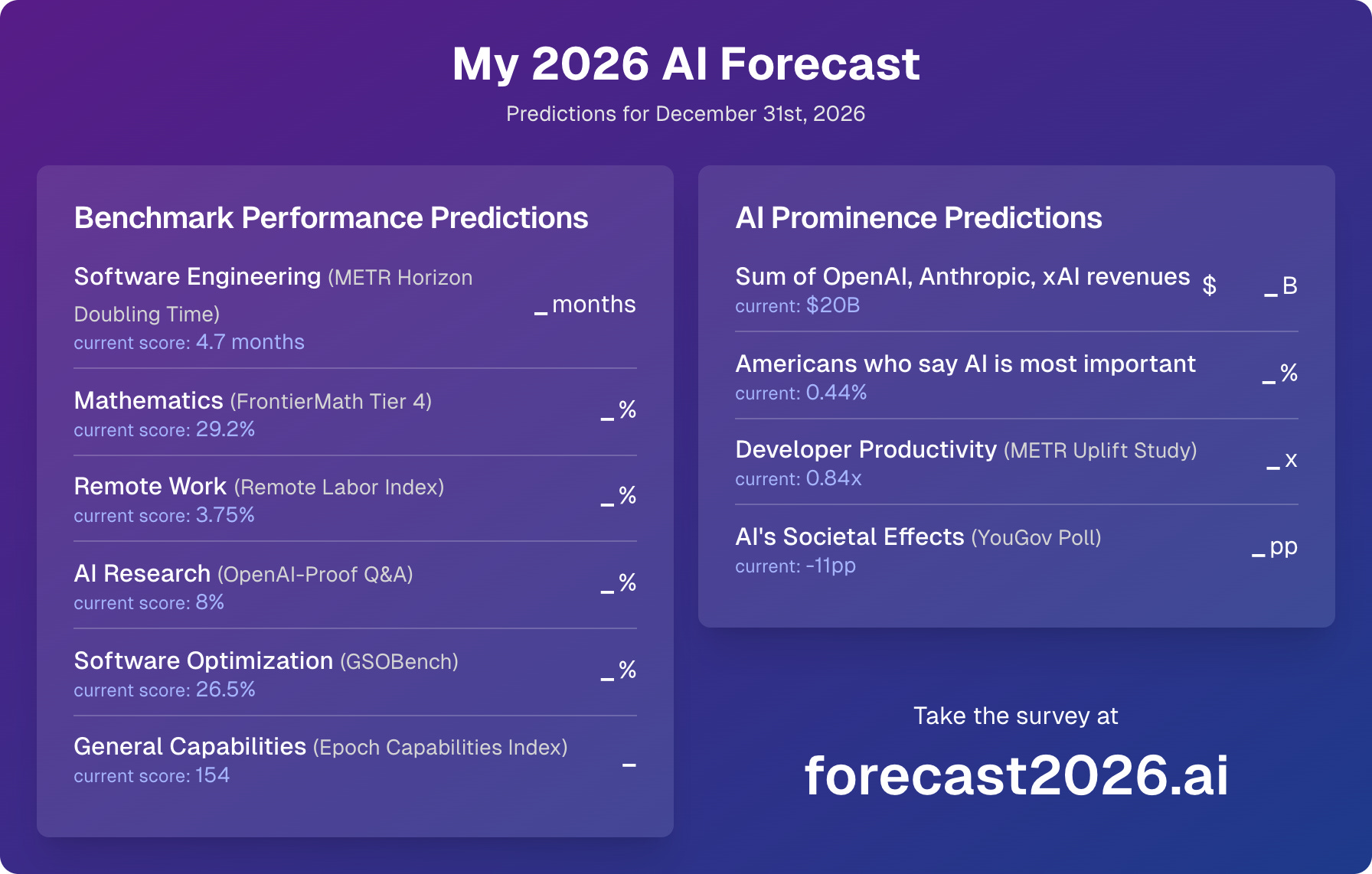
We’ve worked with AI Digest to create a survey where you can forecast how AI will progress in 2026, focusing on the developments that we think are most important to track. We found it useful to pre-register our forecasts in 2025 and compare them to what’s actually happened (more on that below) and thus are excited to do the exercise again.
Take the survey at forecast2026.ai.
An overview of the 2026 questions is below. All questions are optional; you can answer whatever subset you’d prefer.
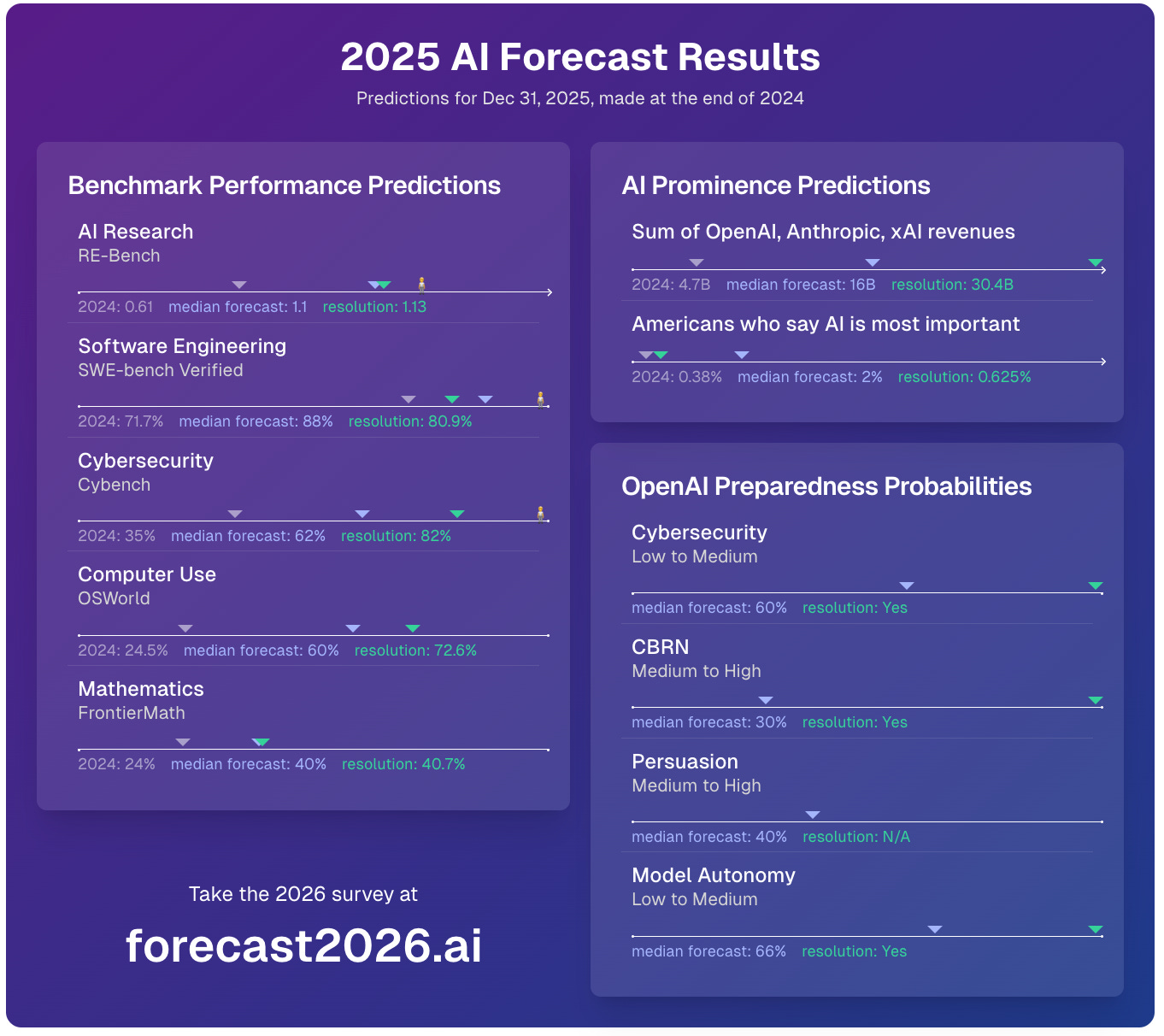
You can read here about how forecasters did in 2025. In short, the forecaster aggregate was about right on benchmarks, underestimated revenue growth, and overestimated public salience. See below for how the aggregate forecast did on each question (the aggregate is simply the median of each forecaster’s median prediction).
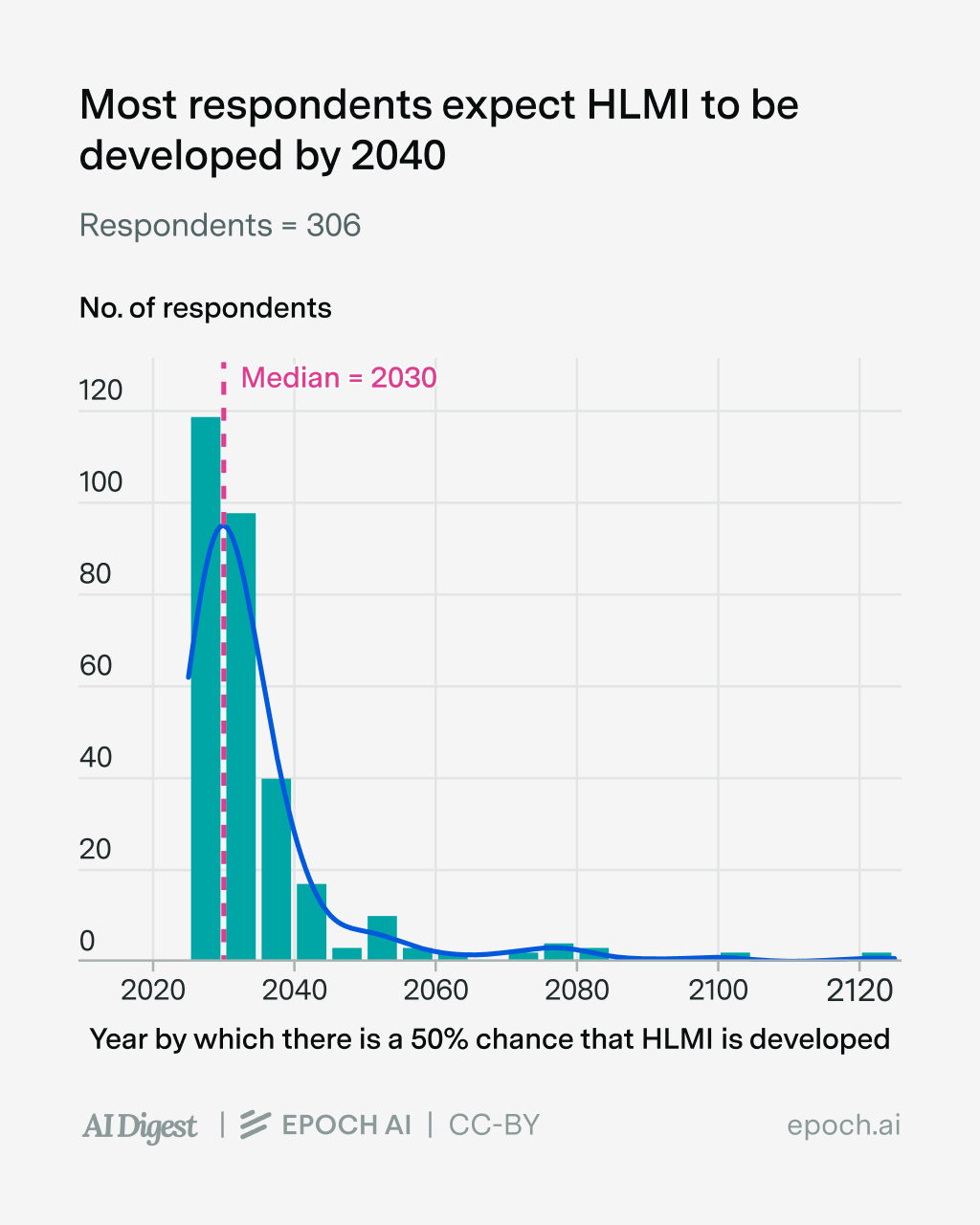
Forecasters overall had fairly aggressive timelines to human-level machine intelligence (HLMI, defined as AIs being better than humans at every cognitive task), with a median of 2030. Since forecasters were about right on benchmark scores, this would naively indicate that we are approximately on track for HLMI in 2030.
Forecasters with median timelines of <=2030 performed similarly to those with >2030 timelines.
How did AI Futures Project staff do? I (Eli) committed to staying anonymous on the leaderboard since I was in charge of resolution decisions and choosing the scoring methodology. Of the staff who predicted and opted into sharing their name alongside their forecasts:
Jonas Vollmer got 10th out of 413 (8th of 275 who predicted after o3)
Thomas Larsen got 16th (14th post-o3)
Daniel Kokoajlo got 41st (8th of 138 pre-o3)
They did particularly well relative to other forecasters on predicting Cybench (which went faster than the forecaster aggregate) and public salience (which increased more slowly than the forecast aggregate).
The question on which Jonas did most poorly relative to other forecasters was predicting SWEBench-Verified performance, overpredicting progress. Daniel and Thomas did most poorly on RE-Bench, also predicting faster progress than materialized.
You can see the full leaderboard at ai2025.org.
We’ll be forecasting again in 2026, so fill out the survey if you’d like to compete with us! The survey closes Sunday January 25th, end of day anywhere on Earth.
End of day Anywhere on Earth (UTC+12), rather than Everywhere on Earth (UTC-12)?
BTW, technically, "Anywhere on Earth" is Line Islands Time (UTC+14).